I'm hiring my first PhD student(s)! Below, you can read about some topics I'm interested in and my case for doing a PhD with me in Vienna. These are extended musings, and you don't need to review everything here to apply.
Update: The deadline for the dedicated position at TU Wien has passed, but you can still apply to the doctoral program at the Complexity Science Hub, due October 15, naming me as an advisor. You would receive a PhD through TU Wien, but you would sit with an interdisciplinary cohort at the CSH.2 The topic remains open, and you can still review my the original posting to get a sense of criteria.
Here is the official job posting at TU Wien (HR reduced the length somewhat and the website has been a little on the fritz; here's the original); basics below:
- The topic is open
- Deadline is July 9 2026 with a flexible start date. Duration is four years
- Submit the usual material: CV, statement of purpose, references,1, etc.
- Some teaching is expected
- Working language is English
- Pays roughly €52,000/year
You can email me at alexander.hoyle@tuwien.ac.at if you have additional, specific, questions (NB, the more you use LLMs to write your email, the less likely I am to respond). I may not answer general questions about fit, since that is best adjudicated through the application process itself. I have been receiving many inquiries so will usually not respond quickly.

Topics
Broadly speaking, my interests are related to the development, evaluation, and application of natural language processing methods in social science. As I've put in my research statements/cover letters/website over the years, I consider social science to serve as a good “problem space” for NLP and AI. The reason is that the social sciences value transparent operationalizations, valid measurement, and human usability. These same properties also happen to make for good NLP! If NLP/AI could begin to meet these needs, then it would be making progress toward our broader goals of reasoning, interpretability, and generalization. Conversely, well-specified computational methods can help answer substantive questions in social science.
That's all relatively high-level, so what follows is a very non-exhaustive list of topics that interest me at the time of writing (along with some papers I've liked in these topics). It is far from a complete list, and I'm open to many different areas—for example, a student recently proposed a digital art history project that I'm very jazzed about, even though I've never worked in that area.
- exploring text data at scale. Methodologically I've thought the recent work applying SAEs to computational text analysis is neat (HypotheSAEs; Zheng et al. 2025); topically I'm interested in the spread of narratives and ideologies in social networks, both real and virtual (our paper on inferential decompositions, a follow-up, Maria Pacheco's work, e.g., on media narratives, ConceptCarve, Media Storms);
- the measurement of complex constructs in political science and mental health contexts (our paper on scoring texts with LLMs; Dallas Card et al.'s paper on immigration speeches; Munmun De Choudhury's work on measuring mental health constructs, e.g., Ernala et al. 2019);
- verifiable and structured reasoning in large language models;
- developing evaluations that consider real-world use and (ideally) involve experts (Ziang Xiao and Vera Liao's position paper on rethinking socio-technical gap; our paper on issues with topic model evaluation metrics, our follow-up).
As additional context, here is an incomplete list of other junior faculty whose approach and work I admire: Maria Antoniak (incredibly thoughtful about research/academia/most things; lots of great work on narrative understanding at scale and cultural NLP), Dallas Card (wrote a favorite topic modeling paper of mine, a nice treatise on power analysis for NLP, and the immigration paper above), Anjalie Field (have enjoyed her recent work on inductive coding and qualitative interview quality), Andrew Halterman and Katie Keith (who jointly published the codebook LLMs paper that I've been referencing a lot), Abbie Jacobs (her work made me recognize the importance of measurement), Lucy Li (often takes a very diligent and non-lazy approach that enables cool work, like scanning hundreds of textbooks or student math answers by hand), Julia Mendelsohn (works on exciting things like dehumanizing language and dogwhistles, and gives good talks about them), Maria Pacheco (develops novel, formally-inspired NLP approaches for social science applications and so is a big inspiration), Ziang Xiao (also really cares about measurement).

What I look for / my supervision style
A genuine intellectual curiosity—and positive attitude—are the most important traits for prospective students.
Good communication skills are also crucial, because I believe that writing and speaking are the best way to develop understanding and hone your research direction. Meeting with students has been my favorite part of my job as a postdoc; we will spend hundreds of hours in discussion over the course of a PhD, so you should be able and willing to throw around ideas (and willing to defend them).
My approach to advising is still nascent, but I work best with people who show initiative and have considered opinions---you should not be shy to express disagreement! We are all fallible, especially me.

On doing research in Vienna
I'm planning to write a longer post regarding my own decision to remain in Europe, but I wanted to share some brief thoughts on why I think Vienna is a nice place to do a PhD—noting that my view is necessarily limited because I haven't even started the position.
First, the AI scene in Vienna is strong and growing rapidly. There is a cross-institutional AI center starting up (covering both TU Wien and the University of Vienna), a large GPU cluster with H200s, along with other interdisciplinary AI research groups like AITHYRA, the Comprehensive Center for AI and Medicine, and the ELLIS unit. TU is already very strong in computer science generally, and the faculty at the department (as well as the dean) are invested in further improving its global standings and visibility. Meanwhile, the Complexity Science Hub (~ the EuropeanSante Fe Institute) is a site for wide-ranging interdisciplinary work (e.g., modeling electoral politics with methods from statistical physics). Last, Uni Wien has major social science departments, plus a strong NLP faculty of its own.
A fringe benefit of Europe generally is that research stays appear much more prevalent here than in the US.3 These are a great way to expand your network and to collaborate with new researchers on different topics; for example, a PhD student in the TU Data Science group is currently spending a few months at Bocconi in Milan.
For Vienna as a city: while I haven't yet relocated, I have loved my visits, and it consistently places at the top of quality-of-life rankings globally (recognizing that a measurement of something as nebulous as “life quality” is bound to be flawed). There's great public transportation, museums, concerts, parks, access to nature, and—I was surprised to learn—a great food scene.
It's also affordable! To start, PhD salaries are competitive with top CS programs in the US, even in nominal terms. Yet Vienna is a city where rent for an entire apartment is as much as a single room in a major US city.4 Usually this tradeoff would involve living somewhere boring, ugly, or inaccessible (or all three!)—instead you can live in a city so beautiful its historic center is a UNESCO world heritage site.
On not doing research in the US
The US appears to be a more difficult place to do research relative to when I was doing my PhD.
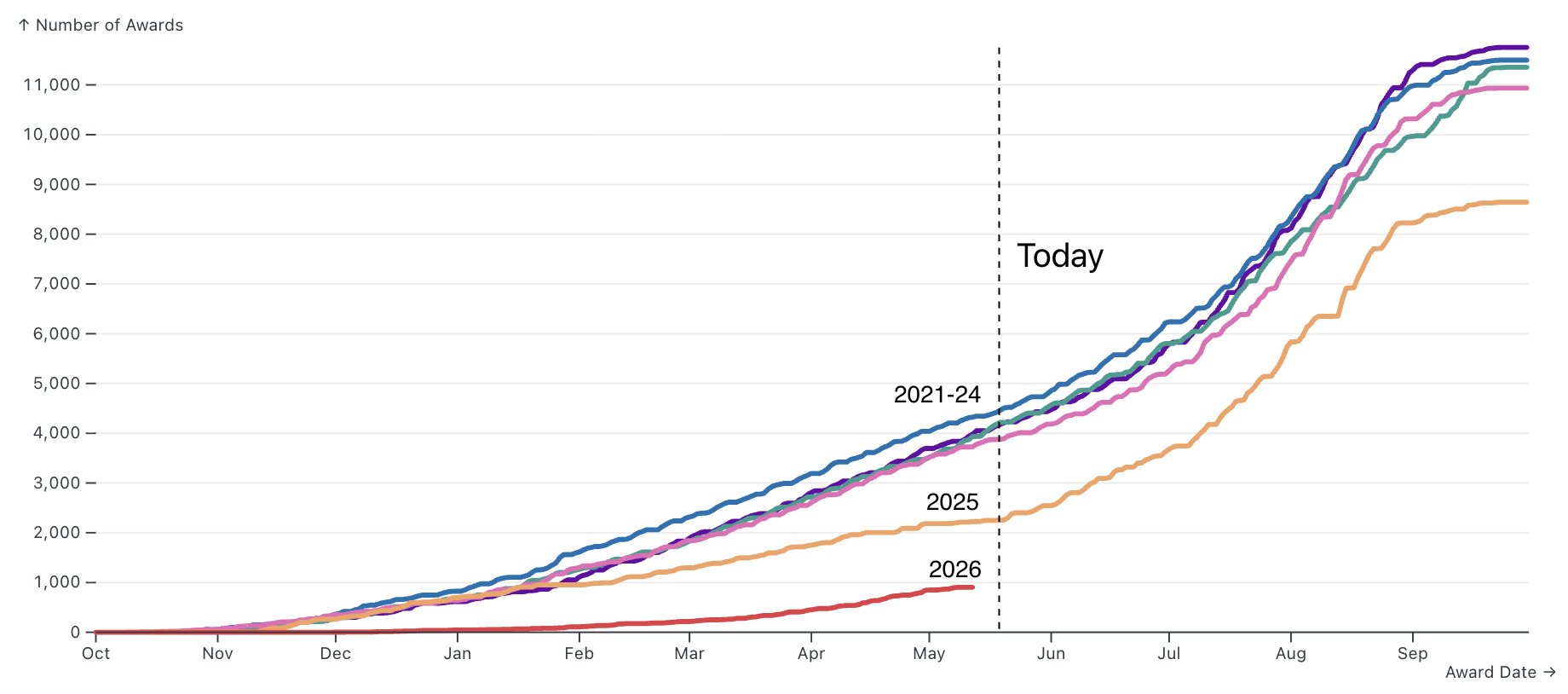
It also looks to be getting even tougher to be an international student. When I did my PhD in the US, my international friends moonlighted as pro se immigration lawyers, constantly navigating byzantine work requirements, countless fees, and endless acronyms.
That was during a “good” administration. Under Trump II, it is harder to get a visa; it is harder to leave the country once you do have a visa (e.g., for conferences); it will be harder to get a job after you graduate; it is harder to stay in your program long enough to graduate; it is harder to exercise your right to free expression; it is harder to avoid being detained indefinitely against your will.
While the EU does have issues with third-country nationals, from my admittedly incomplete perspective, the situation appears to be better.